


GAP Regional Transportation and Infrastructural Development Project
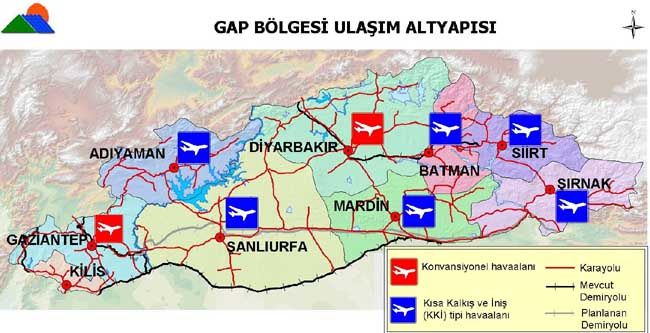
Republic of Turkey Prime Ministry GAP Regional Development Administration GAP Project is a large scale and multi sector regional development project planned for South Eastern Anatolian Region of Turkey. GAP, is one of the most challenging regional development projects ever undertaken all over the world, and is the national project of top-priority in Turkey. GAP comprises all other sectors including industrial, transportation and social sectors apart from irrigation and power generation. The main components of the project are as follows: Urban Infrastructure Planning: Planning the infrastructural requirements in minor rural and urban settlements, which take place within the jurisdiction of certain provincial capitals and county seats. The population of the settlements in the study area, varies from 10 000 to 1 200 000 people. Regional Transportation Planning In transportation planning studies, the year 1988 was selected as the base year for all infrastructural and other studies on transportation systems. In this context, inventories and physical infrastructural systems consisting of roads, seaports and pipelines were studied and their capacities were calculated. Data and parameters for regional socio-economic conditions apart from existing transportation infrastructure were defined. Transportation organizations in the region were enquired of to verify the defined cargo/passenger movements. Status of infrastructure in the base year was determined on the basis of inventory surveys and field observations of related public agencies. The adopted simulation model was calibrated by the data for the year 1988. Basic inputs into the model consisted of population, employment, gross domestic product, car ownership, cargo/passenger transportation prices, cargo/passenger traffic on existing transportation systems and physical features and capacities thereof. Outputs of the model were the traffic flows on the main transportation network and the system performance indicators calculated on the basis of these flows. Model outputs for target year 2005 were used to define the congestions and bottlenecks arising from cargo/passenger transportation demand. Strategies to overcome these bottlenecks were developed and alternative transportation networks were proposed on the basis of these strategies to meet the potential cargo/passenger transportation demand. Each alternative was checked in the model and three main systems comprising different investment options were defined. Performance indicators of each system were calculated separately. Systems were evaluated in view of economy, using the calculated performance indicators, infrastructure operation and maintenance costs, cargo/passenger time economic values and added value losses for the untransported cargo. On the basis of this evaluation, the optimum solutions were defined and proposed.
Client
Partners
Temelsu Ul. Müh. Hiz. A.Ş. (Turkey)
Dapta ProjeTaah. Ltd. Şti. (Turkey)
Temel Müh. Ltd. Şti. (Turkey)
Financing
Local
Duration of Services
1990 – 1993
Brief Description of the Project :
Scope of Services :

